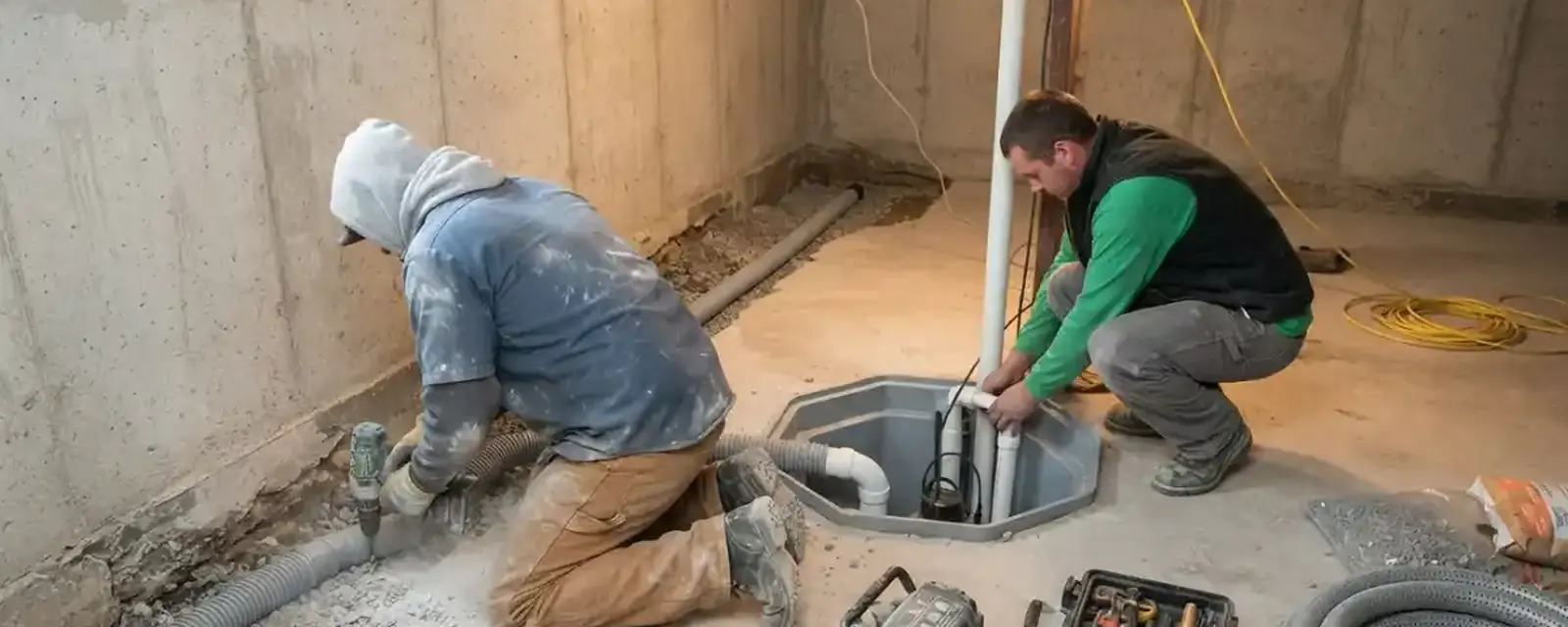
Basement waterproofing in Marblehead, MA
Basement waterproofing keeps groundwater from entering the living space. For plumbers, that mostly means interior drainage: a channel along the footing that collects water and directs it to a sump pit, where a pump lifts it out of the house. Exterior grading, gutters and wall sealing are part of the picture too.
Before any work, we find out where the water comes from. Water entering through a crack in a wall, through the joint between wall and floor, up through the slab or from a plumbing leak each calls for a different fix.
Wet basements on the Marblehead coast
Much of Marblehead is low, rocky and close to salt water. Properties near the harbor or at the bottom of a slope tend to see water table changes after storms, and the same rain that fills a pit can arrive with high tides.
Ledge makes interior drains more difficult in some houses, because cutting through rock-adjacent concrete is slow work. We look at the floor and the ledge line before promising a layout.
Drain and sump work is held to the standards of the Uniform State Plumbing Code, 248 CMR 10.00, and Marblehead's by-laws set the rules on where groundwater may be discharged. Ask the Department of Public Works what applies to your lot before the design is final.
Find the source first
Water that appears after rain and at the wall base is groundwater. Water that is there in dry weather may be a plumbing leak, a condensation problem or a leaking water heater. A moisture meter, a plastic sheet taped to the wall and a look at the gutters and grading help tell them apart.
A plumber can rule out plumbing causes quickly. If the source is a plumbing leak, you save the cost of a waterproofing system you did not need.
Interior drains and sump pits
An interior drain system cuts a channel along the perimeter of the basement floor, lays perforated pipe in gravel and relieves water pressure under the slab. The pipe leads to a sump pit with a pump, and a battery backup protects against power outages.
This is invasive work with concrete cutting and dust, so we explain the sequence and the clean-up before it begins.
Wet basement?
Call to talk through the source and the options.
Walls, cracks and sealing
Hairline cracks can be sealed with injected resin or a flexible sealant. Interior paints and coatings slow damp but do not stop water under pressure. Exterior waterproofing, with excavation to the footing, is a much larger job and belongs to a specialist contractor.
What to do first: grading, gutters and the sump
- Extend downspouts several feet from the foundation.
- Slope soil away from the house.
- Clean gutters before storms.
- Test your sump pump with a bucket of water.
Indoor air and mold
A damp basement grows mold and carries a musty smell into the whole house. Drying the space quickly, using a dehumidifier and fixing the source are the main protections. For visible growth beyond a small patch, consult a mold professional.
Waterproofing approaches compared
Each approach addresses a different path for water. The right one follows the diagnosis.
| Approach | Addresses | Limit |
|---|---|---|
| Grading and gutters | Surface water at the foundation | Does not help groundwater |
| Crack injection | Cracks in walls | Does not stop slab water |
| Interior drain and sump pump | Groundwater pressure | Needs a place for discharge |
| Exterior waterproofing | Water at the wall | Major excavation |
What affects the price of waterproofing
The price depends on the size of the basement and the system. We confirm it before work starts.
Homeowners insurance usually excludes groundwater seepage and gradual leakage. Ask about a water backup endorsement and check what it covers.
Basement waterproofing questions
We focus on interior drainage, sump pits and pumps. Exterior excavation is a specialist job, and we tell you when it is the better route.
If the water is groundwater and the pit sits in the right place, often yes. A diagnosis tells you.
Groundwater rises and pressure builds under the slab. Drainage and a pump relieve it.
It helps with dampness but not with water entering through the walls or floor.
Yes. A leak, a sweating pipe or a leaking water heater are common. See leak detection.
Most are completed in a few days, depending on size and the condition of the slab.
Related help
A pump that is not working is a sump pump repair call. Water from inside the house may be a leak, and backups through floor drains are covered in drain cleaning. We also serve Salem and Swampscott.